Best Teaching Practices of Sciences in Upper Secondary Education: An Opportunity to Enhance Educators’ Formation
DOI:
https://doi.org/10.33064/2026docere349186Keywords:
best teaching practices, sciences teaching, teachers’ preparation, upper secondary education, educational innovationAbstract
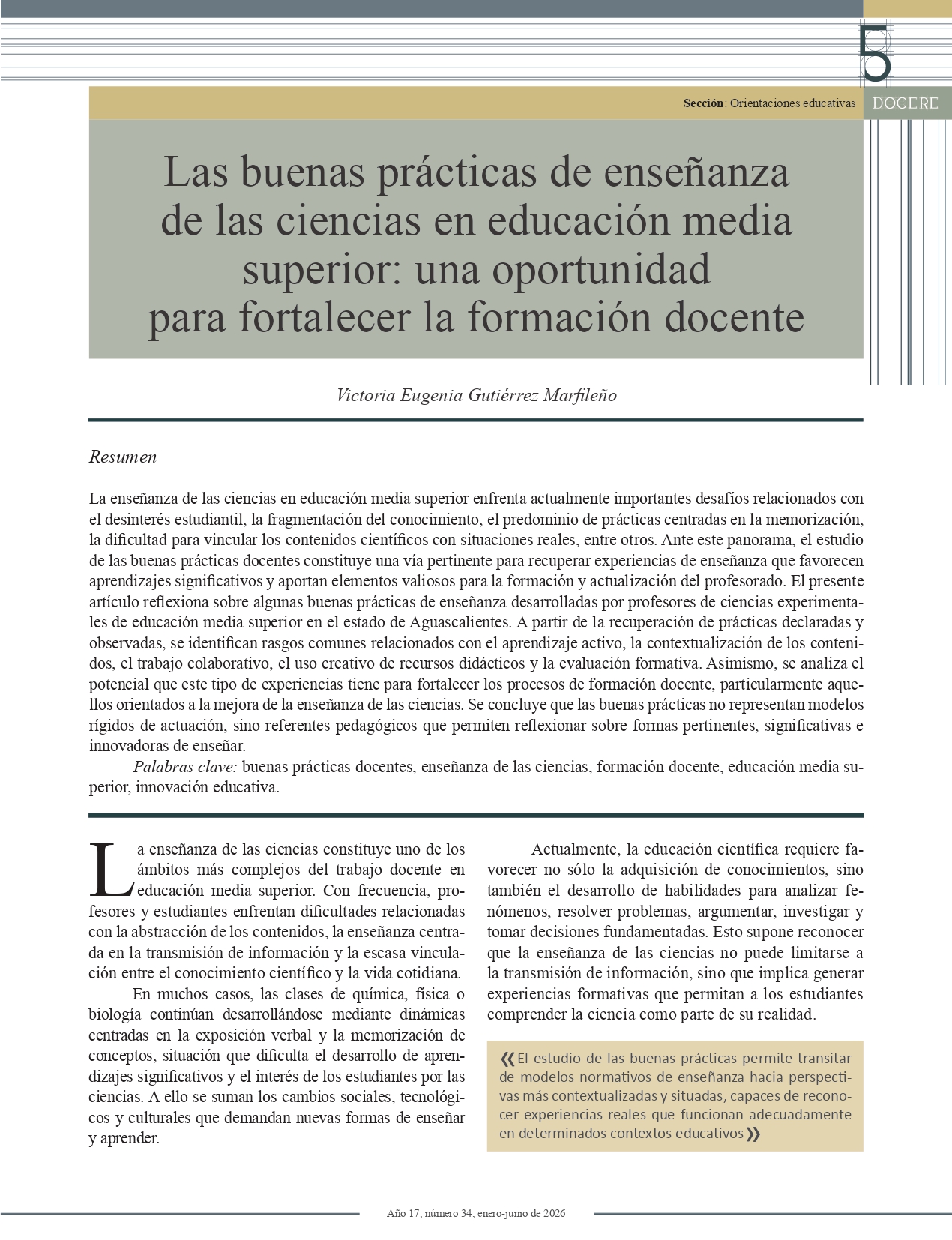
Science teaching in upper secondary education faces important challenges related to lack of interest from students, the decentralization of knowledge, and the dominance of practices focused on memorization and difficulty to connect the scientific content with real situations, among others. In light of this, the study of the best teaching practices constitutes a pertinent way to recover teaching experiences that promote meaningful learning and provides key elements to educators’ formation and improvement. This article reflects on some of the best teaching practices developed by experimental sciences educators on upper secondary education in the state of Aguascalientes. From the retrieval of declared and observed practices, common features related to active learning, contextualization of contents, collaborative work, the use of creative teaching aids, and formative evaluation were identified. Furthermore, the potential of this type of experiences to enhance educators’ training, particularly the ones focused on the enhancement of teaching sciences, is analyzed. In conclusion, best practices do not represent rigid models of action; instead, they represent pedagogical referrals that reflect on relevant, significant and innovative ways of teaching.
Translated by Adán Israel Vázquez Alba
Downloads
References
Cid-Sabucedo, A., Pérez-Abellás, A., & Zabalza-Cerdeiriña, M. A. (2009). Las prácticas de enseñanza declaradas de los “mejores profesores” de la Universidad de Vigo. RELIEVE, 15(2), 1-29. https://www.redalyc.org/pdf/916/91612906008.pdf
Durán, R., & Estay-Niculcar, C. (2016). Formación en buenas prácticas docentes para educación virtual. RIED. Revista Iberoamericana de Educación a Distancia, 19(1), 209–232. https://doi.org/10.5944/ried.19.1.13845
Oliveira, A. W., Wilcox, K. C., Angelis, J., Applebee, A. N., Amodeo, V., & Snyder, M. A. (2013). Best practice in middle-school science. Journal of Science Teacher Education, 24(2), 297-322. https://doi.org/10.1007/s10972-012-9293-0
Shulman, L. S. (1989). Paradigmas y programas de investigación en el estudio de la enseñanza. En M. C. Wittrock (Ed.), La investigación de la enseñanza I. Enfoques, teorías y métodos (pp. 9-91). Paidós.
Zabalza Beraza, M. A. (2012). El estudio de las “buenas prácticas” docentes en la enseñanza universitaria. REDU. Revista de Docencia Universitaria, 10(1), 17-42. https://doi.org/10.4995/redu.2012.6120
Downloads
Published
How to Cite
Issue
Section
License

This work is licensed under a Creative Commons Attribution-NonCommercial-ShareAlike 4.0 International License.